We usually learn biology through a simple information pathway: DNA → RNA → protein. DNA can also make a copy of itself. In both cases, a DNA or RNA strand acts as a template: it carries the sequence information for the molecule being built.
A new study of a bacterial antiviral-defense system reveals an unusual form of DNA synthesis. One of its enzymes can build a precise repeating DNA sequence without reading a DNA or RNA template for that strand. Template-independent nucleotide addition is not itself new; what is unusual here is that the enzyme produces a reproducible sequence pattern, with its own protein structure and chemistry helping direct which nucleotide is added next. This does not overturn the central dogma—but it expands our understanding of how biology can control DNA synthesis.
First, what is a template?
A template is a molecule that contains the instructions used to build another molecule. When DNA is copied, the bases pair in a predictable way: A pairs with T, and C pairs with G.
New DNA: T A C G
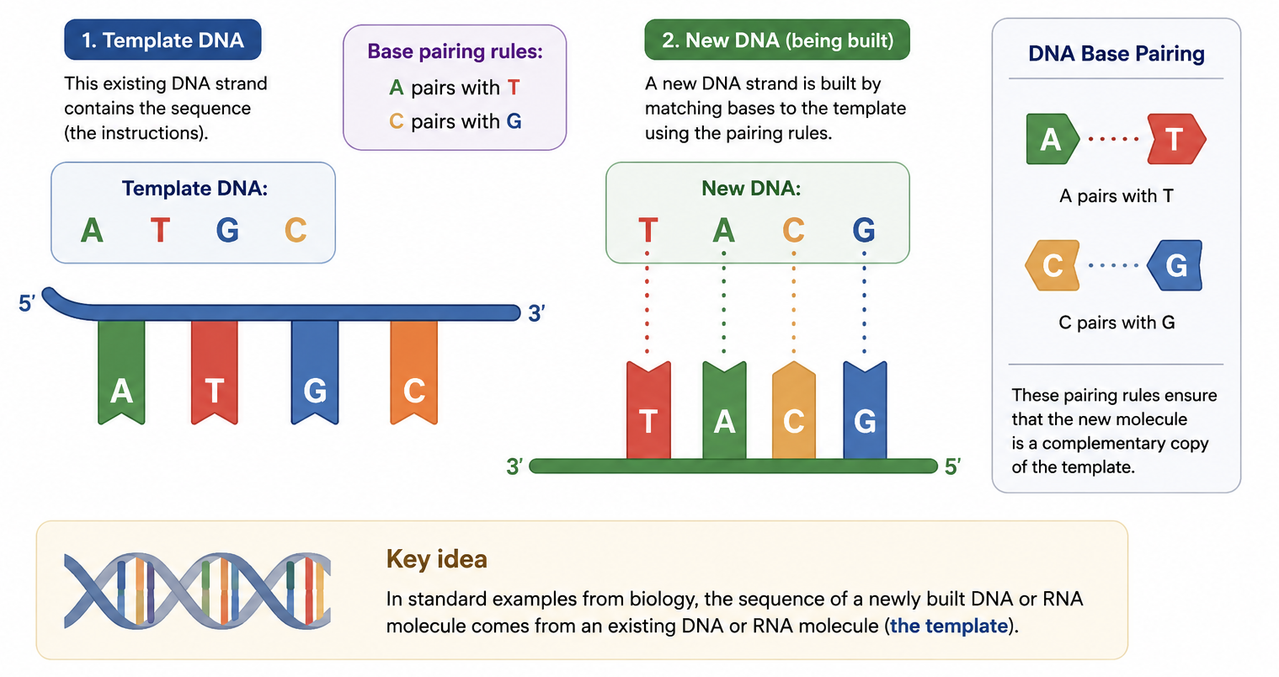
In standard examples from biology, the sequence of a newly built DNA or RNA molecule comes from an existing DNA or RNA molecule.
The unusual system: DRT3
The study focuses on DRT3, a defense system found in bacteria. Its role is to help bacteria respond to bacteriophages—the viruses that infect bacterial cells.
DRT3 contains two related enzymes, Drt3a and Drt3b, along with a small non-coding RNA. Together, they make two complementary repeating DNA strands:
poly(AC): ACACACACAC...
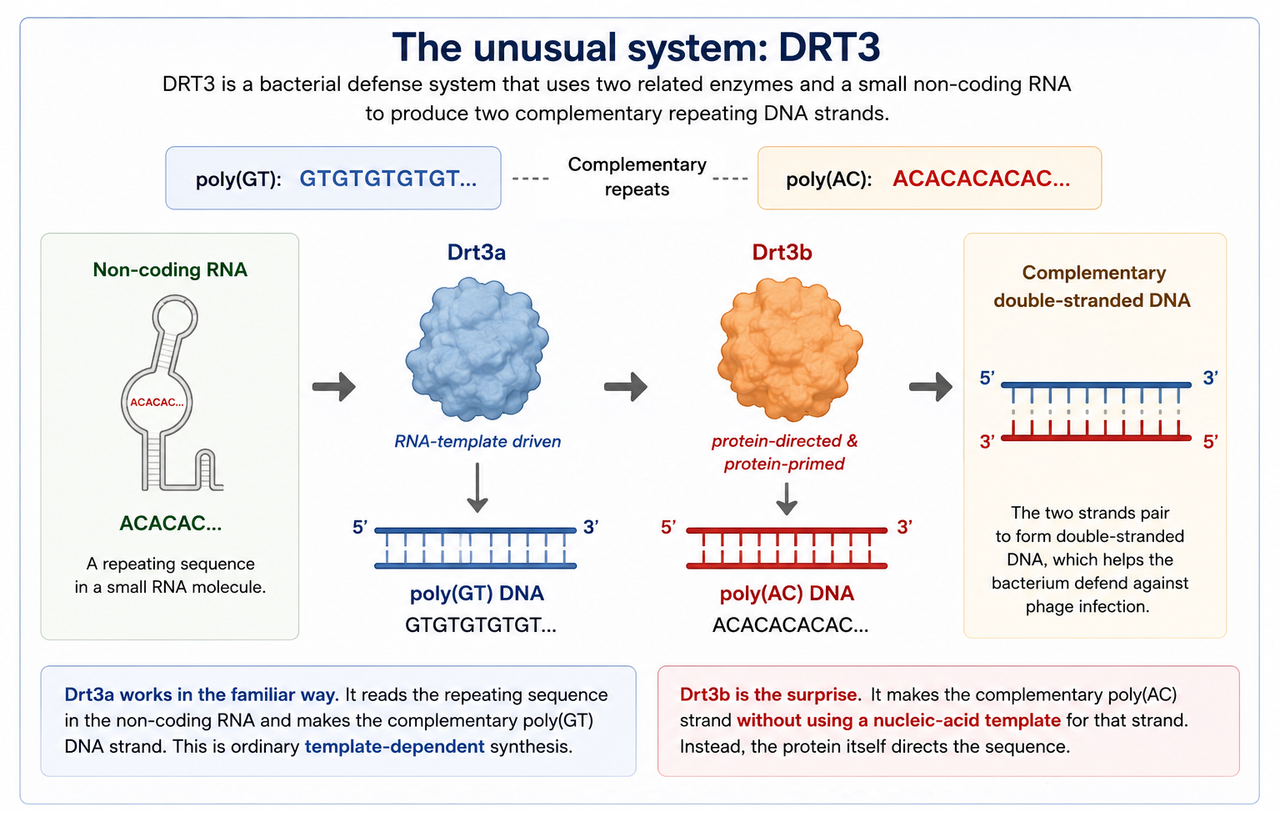
The first enzyme, Drt3a, works in the familiar way: it reads a repeating sequence in the non-coding RNA and makes a complementary poly(GT) DNA strand. That is ordinary template-dependent synthesis. The surprise comes from Drt3b, which makes the complementary poly(AC) strand without using a nucleic-acid template for that strand.
How does Drt3b know what to add next?
Drt3b makes the poly(AC) strand in the absence of a DNA or RNA template for that strand. The reaction is protein-primed, and the researchers found that conserved amino acids near the active site help enforce the alternating sequence. So why does its product form a consistent pattern rather than random DNA?
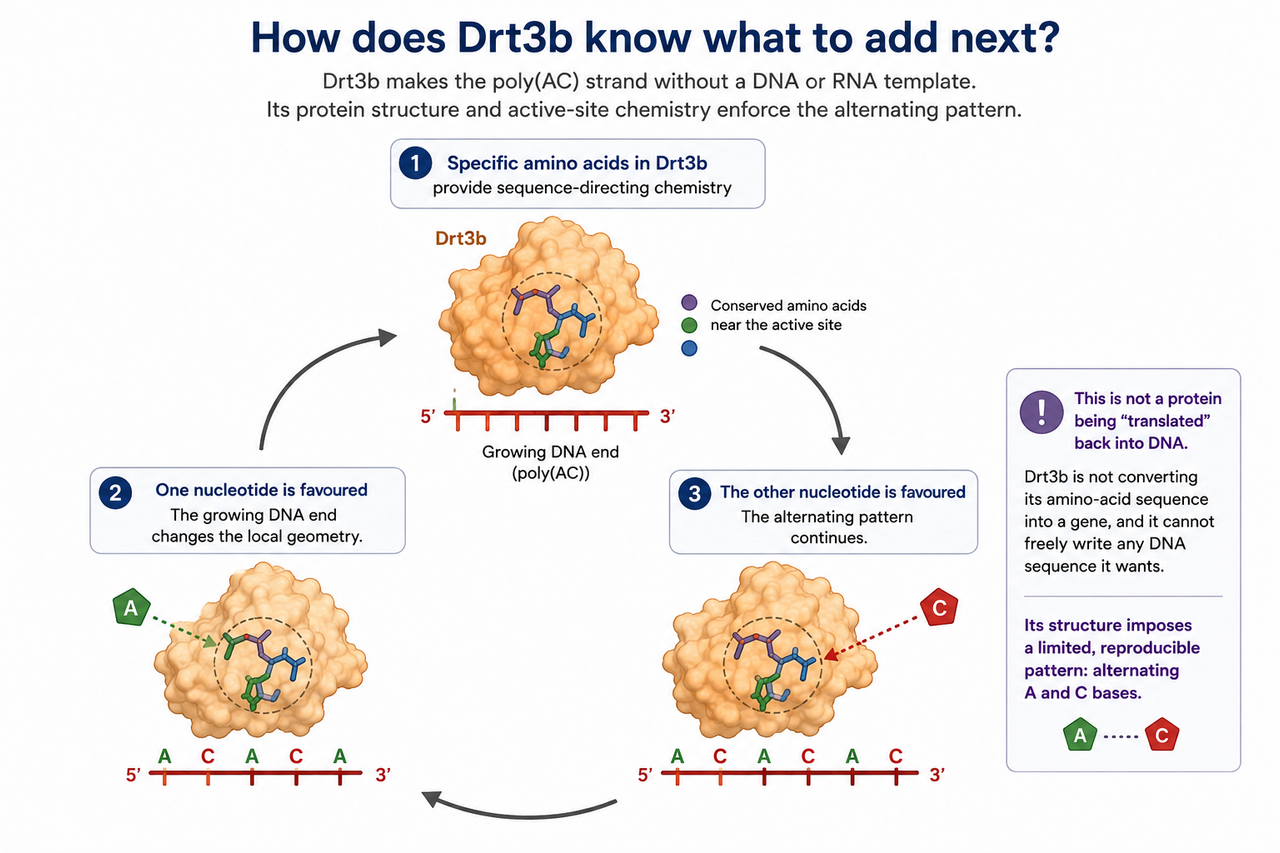
The answer appears to lie in the enzyme’s three-dimensional protein structure and the chemistry of its active site. High-resolution cryo-electron microscopy showed that particular amino acids near the active site help control nucleotide incorporation. As the DNA grows, the local arrangement changes in a way that favours alternating incorporation of A and C.
This is not a protein being “translated back into DNA.” Drt3b is not converting its amino-acid sequence into a gene, and it cannot freely write any DNA sequence it wants. Its structure imposes a limited, reproducible pattern: alternating A and C bases.
Why this matters
The DNA sequence in this study is simple. The important point is the mechanism. Biology already contains enzymes that can add nucleotides without reading a nucleic-acid template. What DRT3 adds is something more specific: Drt3b can produce a reproducible, sequence-specific repeating pattern without a nucleic-acid template, with particular features of the protein helping determine which nucleotide is incorporated next. The result is a constrained pattern rather than an arbitrary DNA sequence.
What does it do for the bacterium?
DRT3 is linked to abortive infection, a bacterial defense strategy. An infected cell may disrupt its own processes to stop a virus from multiplying and spreading to nearby bacteria. The study connects DRT3’s unusual DNA products with this defense response.
However, the exact downstream chain of events—how the repeating DNA ultimately stops phage replication—is still being worked out. That uncertainty matters: this is a major conceptual discovery, but not yet a ready-to-use biotechnology tool.
What this discovery does—and does not—mean
DRT3 does not mean that proteins routinely create genes, that normal DNA replication no longer needs templates, or that the genetic code has been reversed. It shows something more specific: in one bacterial defense system, protein structure and chemistry can guide formation of a particular DNA repeat without a DNA or RNA template for that strand. The mechanism demonstrated here is highly constrained; it is not a general method for freely writing arbitrary DNA sequences.
The bigger picture
Could similar mechanisms exist in other bacterial defense systems? Can related enzymes be engineered to make other DNA patterns? Could this chemistry eventually be useful in biotechnology? These are open questions. For now, the study is a reminder that the central dogma remains a powerful framework—not a limit on all of biology’s chemistry.
Deng, P., Lee, H., Armijo, C., Wang, H., & Gao, A. (2026). Protein-templated synthesis of dinucleotide repeat DNA by an antiphage reverse transcriptase. Science, 392(6804), 1274–1281. Read the paper via DOI ↗